Software as a Service (SaaS)
Software as a Service (SaaS) is a delivery model that has fundamentally changed how we use digital tools in our daily lives. Instead of purchasing a physical disk or downloading a heavy installer to your local machine, you simply log in through a web browser to access powerful applications.
This shift has removed the technical barriers that once kept sophisticated technology locked behind high price tags and complex installation requirements. Whether you are managing personal finances or running a global company, learning the basics of this approach will help you understand how modern business software as a Service (SaaS) products actually function behind the screen.
How Software as a Service Functions
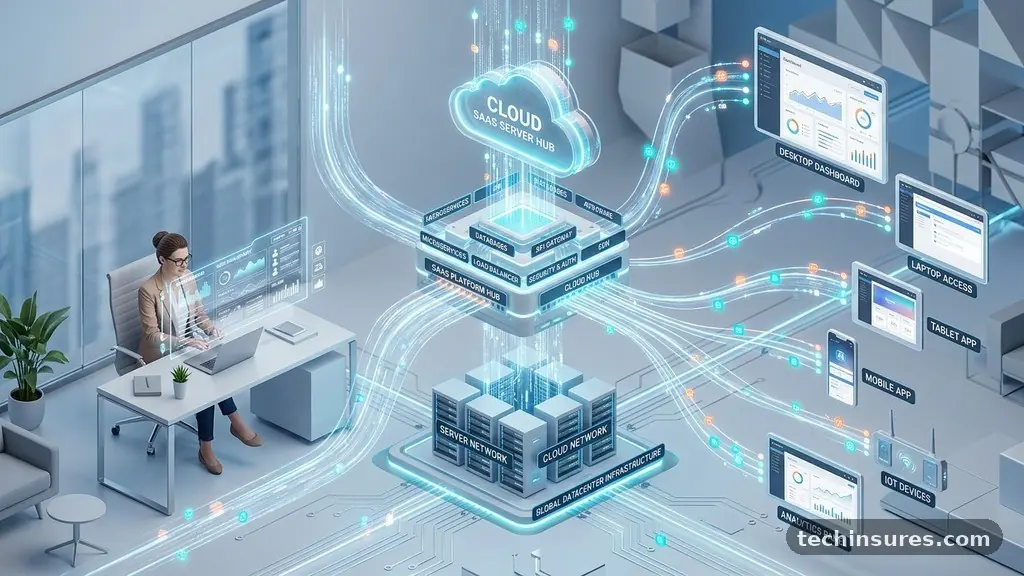
At its core, this delivery model works by hosting applications on central servers rather than on your personal computer. When you use a platform like Gmail or Slack, you are interacting with code that lives in the cloud.
Your computer acts as a portal, sending your commands to the provider’s data centers, which process the request and send the results back to your screen in milliseconds. This architecture allows providers to push updates to millions of users simultaneously without anyone needing to manually download a patch.
Because the software lives on the provider’s servers, the burden of maintenance rests entirely on their engineering team. You do not need to worry about server security, hardware compatibility, or storage capacity for the core application.
Everything is managed behind the scenes, ensuring that all users have access to the most current features at all times. This creates a consistent environment where your data is synchronized across every device you own, from your office desktop to your mobile phone.
The business model behind this is typically subscription-based, which replaces the old “buy once and own forever” approach. You pay a recurring fee—often monthly or annually—to maintain your access to the service.
This setup provides predictable revenue for the provider while giving the customer the flexibility to cancel or scale their usage as their needs change. It is a symbiotic relationship where the provider is incentivized to keep the product useful and reliable so that you continue your subscription.
Why This Model Changed Everything
The primary reason this technology took over the market is the sheer convenience of instant access. In the past, companies spent months coordinating software rollouts across hundreds of workstations, often dealing with installation errors and version conflicts.
Today, a new user can sign up for a service and begin working within minutes of creating an account. This low friction has democratized access to high-end tools that were previously reserved for large enterprises.
Another major benefit is the ability to scale your usage based on actual demand. If you run a small business, you can start with a basic plan that costs very little each month.
As your team grows, you can simply upgrade your subscription tier to unlock more seats or advanced features. You are never stuck with a piece of software that is either too powerful for your needs or too limited to grow with you.
Security and data management have also seen significant improvements under this framework. Most reputable providers invest millions into encryption, automated backups, and disaster recovery protocols that would be impossible for an average small business to replicate on their own.
By centralizing the data, these companies can apply security patches instantly as new threats emerge. This is one of the reasons why the National Institute of Standards and Technology classifies cloud computing as a critical pillar of modern digital infrastructure.
Comparing Traditional Software and SaaS
To understand the difference, it helps to look at the transition from static ownership to dynamic service. Traditional software was a product; you bought a copy, you owned it, and it eventually became obsolete as newer versions were released. Modern cloud-based tools are a service; you are essentially renting the ability to perform a specific task, and the product evolves while you use it.
| Feature | Traditional Software | Modern SaaS |
|---|---|---|
| Deployment | Installed on local hard drive | Accessed via web browser |
| Updates | Manual patches/new versions | Automatic and continuous |
| Pricing | One-time upfront purchase | Recurring subscription fee |
| Data Storage | Local device | Secure cloud servers |
This table illustrates why the shift has been so rapid for both individual users and large organizations. The traditional model required significant upfront capital and a dedicated IT department to manage the hardware.
The modern approach lowers the barrier to entry, allowing anyone with an internet connection to harness the same power that multinational corporations use. It is less about owning a tool and more about achieving a result.
Key Components of the Industry
You might wonder what makes a company successful in this competitive space. It usually comes down to three factors: a clear value proposition, high-quality user experience, and a reliable infrastructure.
A successful product solves a specific problem for its customers, whether that is tracking sales leads, managing project timelines, or facilitating team communication. If the tool is intuitive, users are much more likely to remain loyal subscribers for years.
The rise of no-code platforms has also accelerated the development of these tools. Entrepreneurs who are not professional coders can now build their own functional applications by dragging and dropping elements within a visual interface.
This has led to a massive influx of niche products, often called “micro-SaaS,” which serve very specific industries like dog walking, boutique accounting, or independent bookstore management. It has created a vibrant ecosystem where innovation happens at the edges rather than just at the center.
Integration is the final piece of the puzzle. Modern applications rarely exist in a vacuum; they need to talk to one another to be truly effective.
A marketing tool, for example, might automatically pull data from your customer database and then send an alert to your team’s chat application. This connectivity, enabled by APIs, creates a powerful web of tools that work together to streamline complex business workflows.
How to Start Learning About This Space
If you are interested in entering this field, the best way to start is by becoming a power user of the tools you already enjoy. Pay attention to how the interface changes over time, how the company communicates new feature releases, and how they handle support requests.
You will begin to see the patterns that differentiate a great product from a mediocre one. Understanding the customer journey is the most valuable skill you can develop.
You can also explore the financial side of these businesses. Most public companies in this space report their “Annual Recurring Revenue” (ARR) as a key metric of health.
By looking at how companies balance the cost of acquiring a new customer versus the lifetime value of that customer, you will understand the math that drives the entire industry. It is a fascinating mix of creative product design and rigorous financial discipline.
There are also many free resources online that teach the basics of product management and user interface design. You don’t need a computer science degree to understand how these systems work. Start by observing the tools you use every day, and try to map out the logic behind their design.
Why is the button there? How does the software handle your data when you log out? These questions will lead you to a deeper understanding of the technology.
Common Misconceptions Explained
Many people worry that their data is less secure in the cloud than it is on their own hard drive. In reality, the average person’s local computer is far more vulnerable to hardware failure, theft, or simple user error than a professional data center.
These providers have teams of experts dedicated to preventing unauthorized access and ensuring that your information remains private. Your files are almost certainly safer in a well-managed cloud environment.
Another myth is that you need to be a developer to get involved in the industry. While engineers are obviously critical, these companies have massive teams of marketers, support specialists, sales professionals, and designers.
Each of these roles is essential to ensuring that the product actually reaches the people who need it. If you have a talent for teaching, writing, or solving problems, there is a place for you in this ecosystem.
Finally, some believe that all these services are expensive. While enterprise-grade packages can run into the thousands of dollars, the vast majority of products offer a “freemium” model.
This allows you to use the core features for free, with the option to pay for extra storage or advanced functionality later. You can build a very powerful digital workspace for your personal life without ever spending a cent.
Frequently Asked Questions
Is ChatGPT considered a SaaS product?
Yes, it is a perfect example of this model. You access the artificial intelligence through a web interface, the heavy processing happens on the company’s servers, and you pay a subscription for premium features.
What does it mean when a tool is described as no-code?
No-code refers to platforms that allow you to build software applications without writing traditional programming languages. You use visual interfaces to define how the software should look and behave, which makes it accessible to non-technical founders.
Is it difficult to learn how to build these products?
It depends on your goals, but it has never been easier to start. With modern tools, you can prototype an idea in a single afternoon without needing to write a single line of code. The challenge is usually finding a real problem to solve rather than the technical execution itself.
How do I know if a subscription is worth the cost?
Look at how much time the tool saves you or how much value it adds to your work. If a $20 monthly subscription saves you five hours of manual labor, it is almost certainly a good investment for your productivity.
Can I use these services if I have slow internet?
While these applications do require a connection, most are designed to be quite efficient. They often cache data locally, meaning you can continue working even if your connection blips for a moment.
Future Outlook and Closing Thoughts
The future of software as a Service (SaaS) points toward even deeper integration and more intelligent, personalized experiences. As artificial intelligence becomes a standard feature, these tools will stop being passive interfaces and start acting more like proactive assistants.
They will learn your habits, automate your repetitive tasks, and suggest improvements before you even realize you need them. This evolution will make the software we use feel less like a tool and more like an extension of our own capabilities.
Whether you are a casual user or an aspiring entrepreneur, the barrier to entry for this technology is lower than ever before. You are not just a customer; you are an active participant in an ecosystem that is constantly improving based on your feedback and usage.
Take the time to explore the tools that interest you, and don’t be afraid to experiment with new platforms. The digital world is evolving rapidly, and understanding how these services work is your best ticket to staying ahead of the curve.