
What is the metaverse? If you have heard the word in the news, in a game, or in a headset advert, you are not alone in wondering what it actually means. The metaverse is often described as the next version of the internet: a set of connected, three-dimensional virtual worlds where people can meet, work, play, learn and shop using avatars, instead of just looking at flat web pages. This beginner’s guide explains the metaverse in plain language, how it works, what you can do in it, and whether it is worth your time.
There is no single metaverse owned by one company. Instead, many different virtual worlds, games and apps are being built, and the hope is that they will one day connect smoothly, so you can move your avatar, your digital items and your identity from one world to another. Some of that already happens, and much of it is still a work in progress. By the end of this guide, you will know the difference between the metaverse, virtual reality and augmented reality, and you will be able to decide for yourself how much of the hype to believe.
What Is the Metaverse?
The metaverse is a persistent, shared, three-dimensional online space. Persistent means it keeps going when you log out: other people carry on meeting, building and trading, and the world changes while you are away. Shared means many people are in the same space at the same time, seeing and interacting with each other. Three-dimensional means you move through it as an avatar, a digital character that represents you, rather than scrolling through a list of posts.
Think of the difference between watching a video about a concert and actually being in the crowd. A normal website shows you information. A metaverse world puts you inside it. You can walk up to a friend’s avatar, talk in real time, look at a virtual product from every side, or sit in a virtual classroom next to classmates from other countries. The experience is meant to feel present, as if you are there, even though your body is at home.
The word itself comes from a 1992 science fiction novel, Snow Crash, by Neal Stephenson, which imagined a virtual world people entered with headsets. Today, companies such as Meta, Microsoft, Roblox, Epic Games and Decentraland are all building parts of that vision, but they do not agree on every detail, and no one company controls the whole idea.
Metaverse vs Virtual Reality vs Augmented Reality
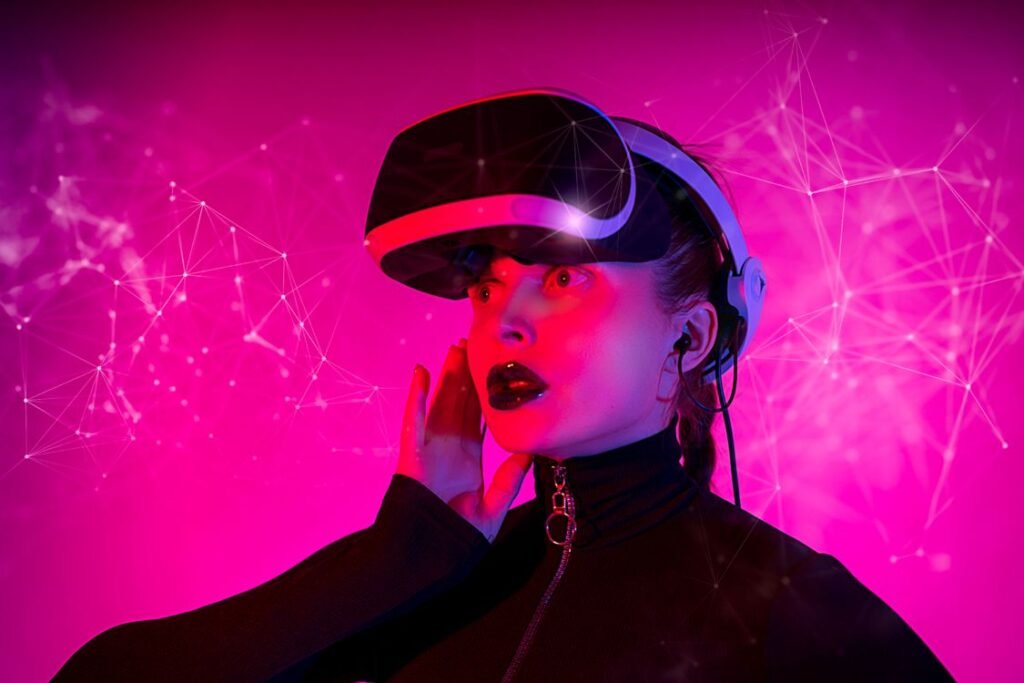
These three terms are often mixed up, so it helps to separate them. Virtual reality, or VR, is a technology: a headset that covers your eyes and replaces the real world with a computer-generated one. You can turn your head and the view changes, which creates a strong sense of being inside the scene.
Augmented reality, or AR, is different. It adds digital images to the real world around you, through a phone camera or special glasses. You still see your room, but a virtual character, a furniture preview or a set of directions can appear on top of it. The metaverse is the wider idea of connected virtual worlds, and VR and AR are two of the main ways to enter them. You can also enter many metaverse worlds on a normal computer or phone screen, without a headset at all.
If you want a deeper look at the headsets themselves, read our guide to what virtual reality is and how VR headsets work. For the technology that overlays digital objects on the real world, see our guide to what augmented reality is and how AR works. Together, those two guides cover the hardware that makes the metaverse feel real.
How Does the Metaverse Work?
The metaverse is built from several technologies working together. At the front is the device you use: a VR headset, AR glasses, a computer, a games console or a phone. That device shows you the virtual world and tracks your movements, so your avatar moves when you do.
Behind the scenes, powerful servers and cloud computers run the world, keep track of where everyone is, and send the right images to each person in real time. Fast internet is important, because a delay of even a fraction of a second can make the experience feel laggy or make you feel unwell in VR. That is why 5G and fibre broadband are often mentioned alongside the metaverse.
Inside the world, software creates the spaces, the physics and the rules. Some worlds are built like games, with quests and points. Others are built like offices, classrooms or shops. Digital items, such as clothes for your avatar, a piece of virtual land, or a work of art, are often recorded on a blockchain, which can prove who owns them and allow them to be bought and sold. Avatars, voice chat and hand tracking let people communicate naturally, using gestures and facial expressions as well as words.
What Can You Do in the Metaverse?
People already use virtual worlds for many different things. Gaming is the most familiar: games such as Roblox, Fortnite and Minecraft are often described as early versions of the metaverse, because millions of players meet, build and play together in shared worlds. In those games, a concert, a film premiere or a new product launch can happen inside the game itself, with avatars attending together.
Work is another growing use. Some companies hold meetings in virtual offices, where colleagues appear as avatars around a virtual table, share a whiteboard, and walk through a 3D model of a building or a product. For remote teams, this can feel more connected than a video call, although it is not yet a replacement for face-to-face work for most people.
Learning and training are also important. Medical students can practise surgery in a virtual operating theatre, engineers can learn to repair a machine without touching the real one, and language learners can practise conversation in a virtual cafe. Because mistakes in a virtual world have no real-world cost, it is a safe place to learn skills that would be dangerous or expensive to practise in real life.
Shopping, entertainment and socialising complete the picture. Virtual shops let you try on clothes with your avatar or see how furniture would look in a virtual room. Virtual concerts and sports events let you watch with friends who live far away. And for many people, the simplest use is social: meeting friends, exploring new places, and building things together, just for fun.
Examples of Metaverse Worlds Today
Roblox is a platform where users create and play millions of games and experiences, from obstacle courses to virtual towns. It is especially popular with younger players, and it shows how user-created content can power a virtual world. Fortnite, best known as a battle game, has also hosted virtual concerts and film events, turning its game world into a social space.
Decentraland and The Sandbox are blockchain-based worlds where users can buy virtual land, build on it, and trade digital items. Their economies are run partly by their communities, and ownership is recorded on a blockchain. Meta’s Horizon Worlds is a social VR world where people can meet, play games and attend events using a Quest headset. Microsoft Mesh, meanwhile, focuses on work, bringing avatars and shared 3D spaces to Teams meetings.
None of these worlds is the whole metaverse on its own. They are separate places, with different rules, avatars and items. The big question for the future is whether they will connect, so that an item or an avatar from one world can be used in another, or whether they will stay separate, like different social networks today.
Benefits of the Metaverse
The main benefit of the metaverse is presence. Being in a virtual place with other people can feel more engaging than looking at a flat screen. That can help remote workers feel like part of a team, help students stay focused, and help friends who live far apart feel closer.
The metaverse can also make experiences more accessible. A person who cannot travel easily can visit a virtual museum, attend a concert, or tour a university campus from home. A small business can open a virtual shop without renting a physical store. A designer can show a client a 3D model of a house before it is built, saving time and money.
Creativity is another benefit. In virtual worlds, anyone can build a space, design clothes for avatars, create a game, or host an event, and share it with a global audience. For creators, the metaverse offers new ways to earn money, through selling digital items, tickets to virtual events, or services inside the world.
Risks and Challenges of the Metaverse
The metaverse is not without problems. Privacy is a major concern, because headsets and virtual worlds can collect detailed data about where you look, how you move, and who you talk to. That data could be used for advertising or, if it leaks, to learn a lot about you. Before you join a virtual world, check what data it collects and how you can control it.
Safety is another concern, especially for children. Virtual worlds can include strangers, inappropriate content and scams, just like the rest of the internet. Parents should use the parental controls, check age ratings, and talk to children about not sharing personal details or meeting online contacts in real life.
Health and cost matter too. Some people feel sick or dizzy in VR, especially at first, so experts advise taking regular breaks and stopping if you feel unwell. Headsets can also be expensive, and not everyone has fast internet or a powerful computer. Until the technology becomes cheaper and more comfortable, the metaverse will remain out of reach for many people.
Finally, there is the risk of hype. Virtual land and digital items have sold for very high prices, and some projects have lost most of their value. Treat the metaverse as a place to explore and learn, not as a guaranteed investment, and be wary of anyone promising easy money.
How to Get Started in the Metaverse
You do not need a headset to start. The easiest first step is to try a metaverse world on your computer or phone. Create an account on a platform such as Roblox or Fortnite, choose an avatar, and explore a public world with a friend. That will give you a feel for how virtual worlds work, without spending anything.
If you want to try VR, borrow a headset if you can, or try one in a shop or at a friend’s house, before you buy. Start with short sessions, adjust the fit and the settings, and choose comfortable experiences first. Set up a guardian or play area so you do not bump into furniture, and keep your account secure with a strong password and two-factor authentication.
As you explore, remember the basics of online safety. Use a nickname rather than your real name if you prefer, do not share your address or financial details, and report anyone who harasses you. The metaverse is a social place, and the same good manners and caution that work online apply there too.
Conclusion
What is the metaverse? It is a set of connected, three-dimensional virtual worlds where people meet as avatars to play, work, learn and shop. It is built on VR and AR, fast internet, cloud computing and, in some worlds, blockchain. It is not one place owned by one company, and it is not finished yet. The worlds we have today are early versions, and the idea of moving smoothly between them is still being built.
For beginners, the best approach is curiosity with caution. Try a world on a screen first, learn how avatars and digital items work, and only then decide whether a headset is worth it for you. The metaverse may change how we work and play, or it may settle into a smaller role alongside the normal internet. Either way, understanding it now means you can make your own mind up, instead of relying on the hype.
Frequently Asked Questions
Do I need a VR headset to enter the metaverse?
No. Many metaverse worlds, including Roblox and Fortnite, can be used on a computer, phone or games console. A VR headset makes the experience more immersive, but it is not required to join, explore or play.
Is the metaverse real?
Yes, in the sense that virtual worlds, avatars and digital items already exist and people use them every day. No, in the sense that the single, connected metaverse often described in the news does not exist yet. What we have today is a collection of separate worlds that may connect more closely in future.
Is the metaverse safe for children?
It can be, with supervision. Choose age-appropriate worlds, turn on parental controls, limit chat with strangers, and talk to children about online safety. Parents should check each platform’s age rating and privacy settings before a child joins.
Can you make money in the metaverse?
Some creators earn money by building worlds, designing avatar clothes, selling digital items, or hosting virtual events. However, income is not guaranteed, prices for virtual land and items can fall sharply, and scams are common. Treat it as a creative opportunity, not as a safe investment.