
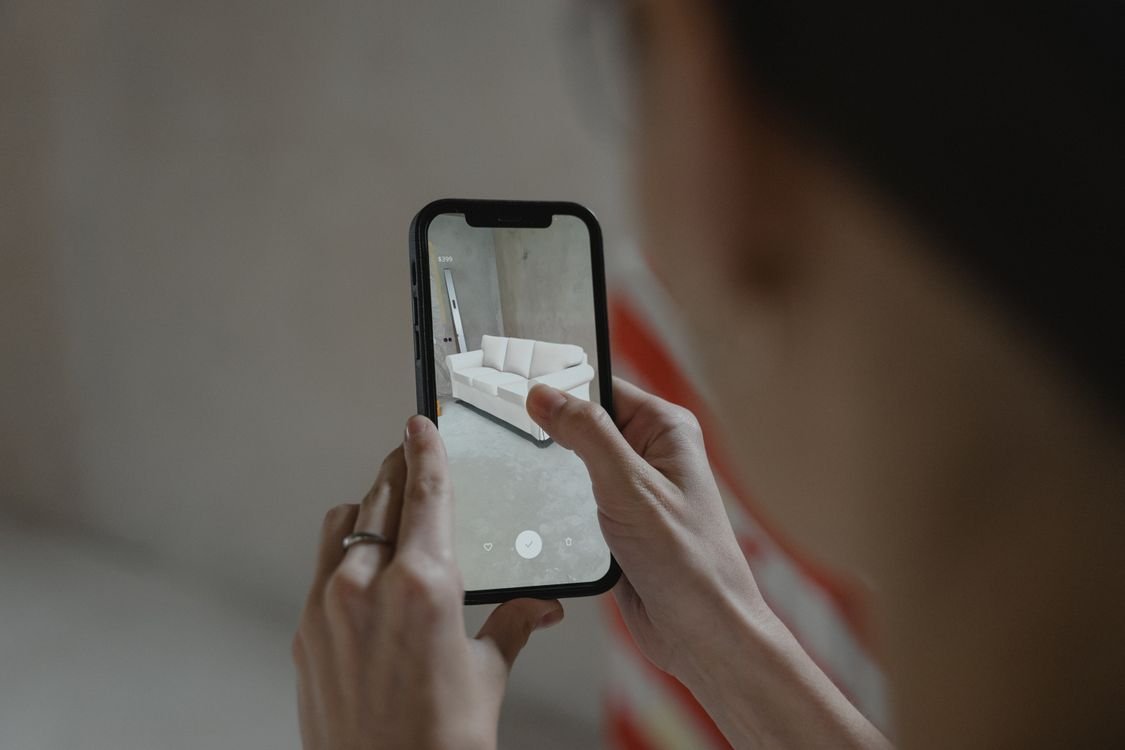
What is augmented reality? Augmented reality, or AR, is technology that adds digital information to the real world around you. Hold your phone up to a room and you might see a virtual sofa placed on your floor, or arrows on the road showing you which way to turn. Wear AR glasses and you might see a label next to a book, or instructions floating above a machine you are learning to repair. Unlike virtual reality, which replaces the world with a completely digital one, augmented reality keeps the real world in view, and adds extra information to it.
AR is already in your phone, your car and your favourite games, and it is about to appear in the form of smart glasses. This guide explains what is augmented reality in plain English, how AR works, how it differs from virtual reality, where it is used today, what its limits are, and what to expect next. The simplest answer to the question of what is augmented reality is: a technology that adds digital images to the real world.
Augmented Reality vs Virtual Reality: What Is the Difference?
The difference between augmented reality and virtual reality, or VR, is how much of the real world is still there. In virtual reality, a headset covers your eyes completely, and you see only a computer-generated world. In augmented reality, the real world is visible, and the computer adds images on top of it. Mixed reality, or MR, is the space in between, with virtual objects that interact with the real world, such as a virtual ball that bounces off a real table.
Put another way, AR adds to your world, VR replaces it, and MR blends the two. AR is more useful for everyday tasks, such as following directions on a real street, because you still see the traffic around you. VR is better for games and training simulations, where you want complete immersion. AR glasses, when they become common, are likely to feel more like ordinary glasses than like a headset, which is why many people think AR is the long-term direction of the technology.
How Does Augmented Reality Work?
An AR system needs to do three things. First, it needs to understand what it sees. Second, it needs to work out where a digital object should appear. Third, it needs to draw that object on screen so that it blends with the world. It does that with a combination of hardware and software, fast enough for your phone or glasses to keep up in real time.
The main tool is a camera, which records the world and sends a constant stream of video to the software. The software looks for distinct visual features, such as corners, edges and patterns, and uses them to map flat surfaces, such as a floor or a table. At the same time, sensors in the device, including the accelerometer, the gyroscope and GPS, track how the device moves and turns. A technique called SLAM, short for Simultaneous Localisation and Mapping, combines the camera and sensor data to build a map of the space and to keep the virtual object fixed in place. That is why a virtual sofa stays on the floor even when you walk to the other side of the room. Finally, the display, either your phone screen or a lens in front of your eye, draws the object with the right size, angle and lighting, so that it looks as if it belongs in the scene. For the technical definition and history, see the Wikipedia article on augmented reality.
What Shapes Does Augmented Reality Take?
AR comes in several forms, and each one suits different uses. The most common is on a phone or tablet, because it needs no extra hardware. Mobile apps can show you a virtual piece of furniture in your room, identify a plant, or translate a sign in real time, using the camera and the processing power the phone already has.
AR smart glasses are the next step. They are glasses with small displays built into the lenses and cameras and sensors in the frame. They show information in front of your eyes while leaving your hands free, which is useful for factory work, surgery and repairs. They are still expensive and heavy compared with normal glasses, but they are improving every year.
Mixed-reality headsets are a third form. Devices such as the Apple Vision Pro and the Meta Quest use cameras to show you the real world on screens inside the headset, and then add virtual objects to it. They are bulkier than glasses, but they offer a wider field of view and more processing power. A fourth form is the head-up display in a car, which projects navigation arrows and speed information onto the windscreen or a small transparent panel, so the driver does not need to look away from the road.
Where Is Augmented Reality Used Today?
AR is used in far more places than you might realise. In shops, apps let you see how furniture will look in your living room, try on glasses or makeup, and scan a product to see its price, ingredients or reviews. In navigation, AR maps show arrows on the road at the point where you need to turn, which is easier to follow than a map alone. In education, AR shows the anatomy of the body or a historical place in 3D, so a student can walk around it.
Healthcare uses AR for guidance in surgery, for learning medicine, and for helping patients understand treatment. Factories use AR for assembly and repair: a worker sees step-by-step instructions and highlights on the machine itself, rather than reading a separate manual. In gaming and entertainment, AR gave us Pokemon Go, where characters appear in the real world, and it is now used in museums and live shows. It is also found in cloud gaming and in smart home apps, where a phone camera can show where a device is and what it is doing.
Augmented Reality vs Virtual Reality and Mixed Reality
| Augmented Reality (AR) | Virtual Reality (VR) | Mixed Reality (MR) | |
|---|---|---|---|
| What you see | The real world, plus digital images | Only a digital world | A blend of real and digital |
| Device | Phone, tablet, AR glasses | A headset | A headset with cameras |
| Best for | Navigation, shopping, repair | Games, training, travel | Design, real-world training |
| Main challenge | Tracking the camera accurately | Creating full immersion | Tracking real and virtual together |
Problems and Limits of Augmented Reality
For all its potential, augmented reality still has real limits. Battery life is one: AR drains a phone battery quickly, because the camera, sensors and screen are all working hard at the same time. Field of view is another: on AR glasses, the digital images appear only in a small area in the middle of your vision, rather than filling your whole view as they do in VR. Price is also a problem: good AR glasses cost hundreds or thousands of dollars, which keeps them out of reach for most people.
There are practical limits too. Tracking can fail in dark rooms or in plain white spaces with few features for the cameras to follow, and bright sunlight can wash out the display on a phone or glasses. Smart glasses are still heavier and less comfortable than normal glasses, and it is not clear whether people are happy to wear a camera on their face in public. That last point is as much about manners and privacy as it is about technology, and it will shape how fast AR glasses are accepted.
Augmented Reality and Privacy
AR raises privacy questions, because it works by recording what your camera sees in order to add a digital layer to it. An AR app can see your room, the people in it, and where you are looking, and it may store that information or send it to a server. If an app is not clear about what it stores, it is hard to know who else could access that data.
To protect yourself, check an app’s permissions before you use it and turn off camera and microphone access when you do not need it. Use AR in private spaces where possible, and tell the people around you if you are recording or scanning. Read the privacy policy before you install an app, and choose apps from companies that explain what they collect and how long they keep it. The best habit is to pause before using an AR feature and ask whether it is worth the data it collects.
The Future of Augmented Reality
The most likely next step is a new generation of smart glasses that look and feel like normal glasses, last a full day on one charge, and work with an AI assistant that can see what you see and help you quietly. Companies including Apple, Meta and Google have released AR glasses or prototypes, and the results have been mixed, with high prices and limited battery life holding back sales.
Even so, the direction is clear. The technology is becoming lighter, cheaper and more reliable every year, and the uses are widening: work training, translation, navigation and everyday assistance. The future will not arrive all at once, and it is likely to be gradual, but AR is likely to become as familiar as the smartphone camera is today. The best way to stay ready is to try it now: the apps are already free, and they are the easiest way to learn what the technology can do.
Conclusion
What is augmented reality? It is the technology that adds digital images to the real world, usually through a phone camera or smart glasses. It is already used in shops, in cars and in games, and it is likely to become as common as a smartphone camera. It works by keeping the real world in view and placing digital images on top of it, aligned so that they stay in place as you move.
AR is still young, but it is already useful, and the best way to learn it is by using it. Try a furniture app, try on glasses virtually, or follow AR walking directions, and you will soon have a feel for what your phone is doing. For the AI behind many AR experiences, read our beginner guide to machine learning, and for the AI that creates images, read our guide to generative AI.
Frequently Asked Questions
What is augmented reality in simple words?
Augmented reality is technology that puts digital images on top of the real world. You see the world as it is, plus extra information, such as a virtual sofa, a navigation arrow, or a label next to an object.
How is augmented reality different from virtual reality?
Augmented reality adds digital images to the real world. Virtual reality replaces the real world with a digital world, using a headset that blocks out everything around you.
Do I need special hardware for AR?
No, not to start. Most AR works on a normal smartphone, using its camera and sensors. Glasses and headsets give a better experience for some uses, but they are optional.
What are some examples of AR?
Pokemon Go is a famous example. Others include furniture apps, navigation arrows on a phone screen, virtual make-up try-ons, and AR in car head-up displays.
Will AR glasses replace my phone?
Not soon. AR glasses are still expensive, heavy and limited in battery life, and phones are better for many tasks. Glasses are likely to become an extra device alongside your phone, rather than a replacement.