
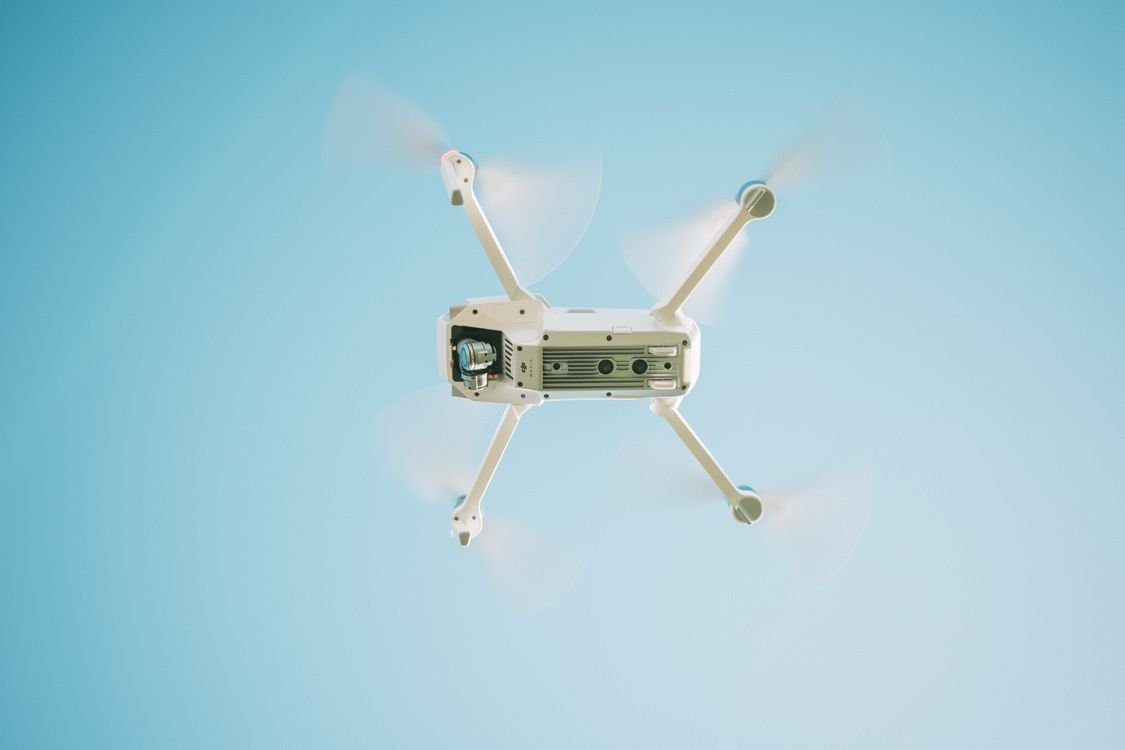
A drone in flight. Photo: Pexels.
Drones have gone from expensive military equipment to everyday gadgets you can buy at an electronics store, fly in a park, and use to take photos from the sky. But how do drones work, exactly? At first glance, a drone looks simple: four spinning propellers, a small body, and a camera. Under that simple shape, though, there is a clever combination of motors, sensors, software, and radio signals working together many times every second to keep the aircraft steady in the air.
Understanding how drones work helps you choose the right one, fly it safely, and get better photos and videos from it. It also helps you understand the rules that apply to drones, because most of those rules exist for a reason: a drone is a real aircraft, even if it fits in a backpack. In this guide, we explain the parts of a drone, how it stays stable, how it is controlled, what it is used for, and what beginners should know before their first flight.
What Is a Drone, Really?
A drone is an unmanned aircraft, often called a UAV, short for Unmanned Aerial Vehicle. Most drones people buy are quadcopters, which means they have four rotors. Each rotor is a propeller driven by a small electric motor. By changing how fast each propeller spins, the drone can rise, sink, move forward or backward, turn, and hover in one place.
There are other kinds of drones too. Some have six or eight rotors for extra lift and safety, and some are fixed-wing drones that look like small aeroplanes and fly much farther. But the quadcopter is the type most beginners meet first, because it is stable, easy to control, and simple to repair. When you see a small drone hovering over a beach or a park, it is almost certainly a quadcopter.
Drones come in many sizes. Tiny toy drones weigh less than 250 grams and fit in the palm of your hand. Camera drones are larger, with a built-in camera on a stabilised mount, and can fly for 30 minutes or more. Professional drones can carry heavy cameras, fly in strong wind, and cost thousands of dollars. The basic idea is the same in all of them: spinning rotors create lift, and a small computer keeps everything balanced.
The Parts That Make a Drone Fly
Every drone has the same core parts, even if they look different from the outside. The frame is the body that holds everything together. It must be light, so the drone can fly longer, but also strong enough to survive a hard landing. Most frames are made from plastic or carbon fibre, and the arms that hold the motors can fold away on travel-friendly models.
The motors and propellers do the lifting. Each motor spins a propeller, and the four propellers work in pairs: two spin clockwise and two spin anticlockwise. This balance stops the drone from spinning out of control. To climb, all four propellers spin faster. To move forward, the back propellers spin a little faster than the front ones, which tilts the drone forward. Turning works the same way, by making one side spin faster than the other.
The battery is usually a rechargeable lithium-polymer battery, the same kind of battery used in phones and laptops. Battery life is one of the biggest limits for drones. Most camera drones fly for 20 to 40 minutes per charge, and cold weather or strong wind can make that shorter. That is why experienced pilots carry spare batteries. The battery also adds most of the weight, so drone makers are always trying to get more flying time from a lighter battery.
The flight controller is the brain of the drone. It is a small computer that reads data from the sensors many times every second and adjusts the motors to keep the drone level. Without it, a quadcopter would be almost impossible for a person to fly, because keeping four rotors balanced by hand is too fast and too complex for human reflexes. The flight controller does that work so the pilot only has to tell the drone where to go.
How a Drone Stays Stable in the Air
A hovering drone looks calm, but inside it is making hundreds of tiny corrections every second. The flight controller uses a gyroscope and an accelerometer to sense tilt and movement. If a gust of wind pushes the drone to one side, the sensors notice the tilt and the flight controller speeds up the motors on the low side to level it again. This happens so fast that the drone appears to simply hang in the air.
GPS is the second key to stability. Many drones use GPS to know exactly where they are. When you let go of the controls, the drone uses GPS to hold its position, even in a light breeze. GPS is also what makes the return-to-home feature possible. If the battery gets low or the signal is lost, the drone can fly back to the spot it took off from and land by itself. It is a useful safety net, but it is not perfect: tall buildings and trees can block GPS, so pilots still need to watch their drone.
Some drones also use a downward-facing camera and sensors to help them hover at low heights, especially indoors where GPS does not work. This is called vision positioning, and it lets a drone stay steady over a table or a floor by watching the ground move below it. Higher-end drones combine GPS, vision sensors, and a barometer, which measures air pressure to judge height. Together, these sensors give the flight controller a clear picture of where the drone is and how it is moving.
How Drones See and Avoid Obstacles
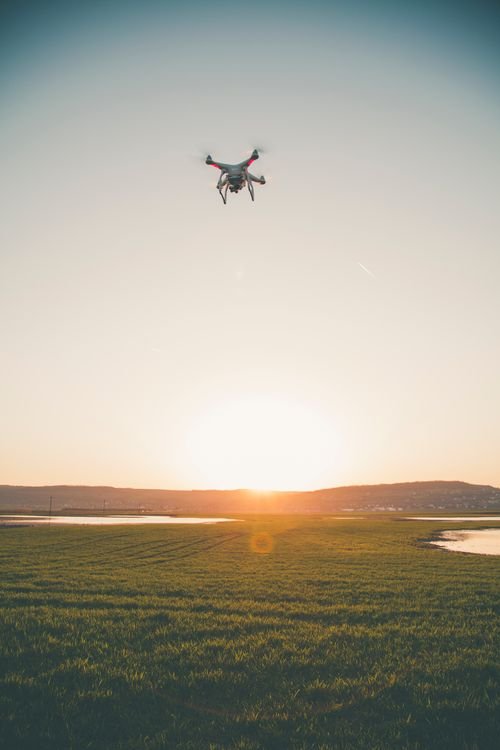
A drone capturing an aerial view at sunset. Photo: Pexels.
Many modern drones can sense obstacles and stop before they hit them. They do this with cameras and sensors that point forward, backward, and sideways. Some use simple infrared sensors, while more advanced models use stereo cameras, which work a bit like human eyes: two lenses see the same scene from slightly different angles, and the drone can judge how far away things are.
Obstacle avoidance is helpful, but it has limits. It works best in good light, with large, clear obstacles such as walls and trees. Thin branches, wires, and glass can be hard for sensors to see, and on a sunny day the camera may struggle with glare. Pilots should treat obstacle avoidance as a helpful backup, not a replacement for watching the drone. Flying slowly in a new area is still the safest habit.
The camera is a big reason many people buy a drone. Most camera drones have a gimbal, a small motorised mount that keeps the camera steady even when the drone tilts or shakes. Without a gimbal, aerial video would be shaky and hard to watch. Some drones can record 4K video and take photos with a larger sensor for better image quality, while cheaper drones offer simpler cameras that are fine for fun and learning.
How Do You Control a Drone?
Most drones are flown with a remote controller, which has two sticks. One stick usually controls height and turning, while the other controls forward, backward, and sideways movement. The controller sends radio signals to the drone and receives video and flight data back. Many controllers have a phone holder, because a phone screen shows the live camera view and settings such as battery level, height, and distance.
Some drones can also be flown from a phone app alone, using on-screen controls. That is handy for a quick flight, but a physical controller usually gives better range and a better feel. More expensive controllers have a built-in screen, which is brighter and easier to see in sunlight than a phone.
Drones also have flight modes that change how they behave. In normal mode, the drone moves gently and is easy to control. In sport mode, it flies faster and reacts more sharply. Beginner mode limits height and distance so new pilots cannot fly too far away. There are also automatic modes for photos and video, such as following a person, circling a building, or flying a set route on its own. These modes make it easier to get smooth, professional-looking video without years of practice.
FPV, short for first-person view, is a popular way to fly. The pilot wears goggles or uses a screen that shows the view from the drone’s camera, so it feels like sitting inside the drone. FPV drones are often faster and more agile than camera drones, and they are popular with racing pilots. They need more practice, but they give a flying experience that no other gadget can match.
What Are Drones Used For?
Photography and video are the most common uses. Drones can take wedding photos from the sky, film a house for a property listing, or capture a coastline at sunset. Real estate agents, travel creators, and filmmakers use drones because an aerial view makes a place look completely different.
Farmers use drones to check crops, spot dry patches, and map large fields without walking them. Inspectors use drones to look at roofs, bridges, wind turbines, and power lines without climbing them. Delivery companies are testing drones to carry small packages in places that are hard to reach by road. Search and rescue teams use drones with thermal cameras to find missing people at night.
Drones are also used for fun and learning. Schools use them to teach coding and engineering, and hobbyists race them, build them, and modify them. If you enjoy connected gadgets, you may also like our guide to smart home devices, which covers another kind of everyday smart technology.
Drone Rules Beginners Need to Know
Drones are fun, but they are also aircraft, and most countries have rules about where and how you can fly them. In many places, drones over a certain weight must be registered, and pilots may need to pass a basic test. In the United States, the Federal Aviation Administration (FAA) sets rules for recreational and commercial flying, and in the UK the Civil Aviation Authority (CAA) does the same. Other countries have their own versions, so check your local rules before you fly.
Some common rules apply almost everywhere. Do not fly near airports or above crowds. Keep the drone where you can see it. Fly below the maximum allowed height, usually around 120 metres, and stay away from private property and other people’s privacy. Many areas, such as national parks and military sites, ban drones completely. If you are unsure whether you can fly in a spot, assume you cannot and check first.
Insurance is worth thinking about, especially for larger drones. A drone can cause damage if it crashes into a car or a person, and a normal home insurance policy may not cover it. Some countries require liability insurance for heavier drones. Even where it is not required, it is a sensible way to protect yourself as you learn.
How Much Does a Drone Cost?
Drone prices start very low and go very high. A small toy drone can cost less than 50 dollars and is a good way to learn the controls without risking much money. A good beginner camera drone usually costs between 300 and 800 dollars, and it will include a decent camera, a gimbal, GPS, and obstacle sensors. Professional drones with larger cameras start at around 1,500 dollars and can cost far more.
When comparing prices, look beyond the sticker price. A drone needs spare batteries, extra propellers, a case, and memory cards for the camera. Some models need a separate subscription for advanced mapping features, so check what is included. Before you buy, you can also explore the free TechInsures Tools hub for handy calculators and generators that help with everyday tech tasks.
Conclusion
So, how do drones work? In short, four spinning propellers create lift, a flight controller makes hundreds of corrections every second to keep the drone stable, GPS and vision sensors tell it where it is, and a radio link lets the pilot guide it from the ground. The camera, gimbal, and obstacle sensors add the features that make drones useful for photos, inspections, farming, and fun.
A drone is a remarkable piece of technology, but it is also a responsibility. The best way to enjoy it is to start with a simple model, practise in an open space, learn the rules in your area, and build your skills slowly. Do that, and a drone will give you a view of the world that is hard to get any other way.
Frequently Asked Questions
How do drones fly without a pilot on board?
A drone flies using a flight controller, a small computer that reads gyroscope, accelerometer, and GPS data many times per second. It adjusts the speed of each propeller to keep the drone level and to follow the pilot’s commands from a remote controller or phone app.
How long can a drone stay in the air?
Most camera drones fly for 20 to 40 minutes on one battery charge. Small toy drones may only manage 5 to 10 minutes, while large professional drones can fly for an hour or more. Wind, cold, and heavy cameras all reduce flight time.
Do I need a licence to fly a drone?
It depends on where you live and how heavy your drone is. Many places require registration or a basic test for drones over 250 grams, and extra rules apply for commercial flying. Check your local aviation authority, such as the FAA in the United States or the CAA in the UK, before your first flight.
Can drones fly in rain or strong wind?
Most consumer drones are not waterproof and should not be flown in rain. Strong wind makes flying harder and drains the battery faster. Most makers advise against flying in winds above 20 to 30 kilometres per hour, and beginners should stick to calm, dry days.
What is the best drone for a beginner?
A good beginner drone is light, stable, has GPS and return-to-home, and costs less than a professional model. Look for a model with obstacle sensors, a protected camera, and a beginner mode. Practise in an open field before trying to take photos or videos near buildings and trees.